
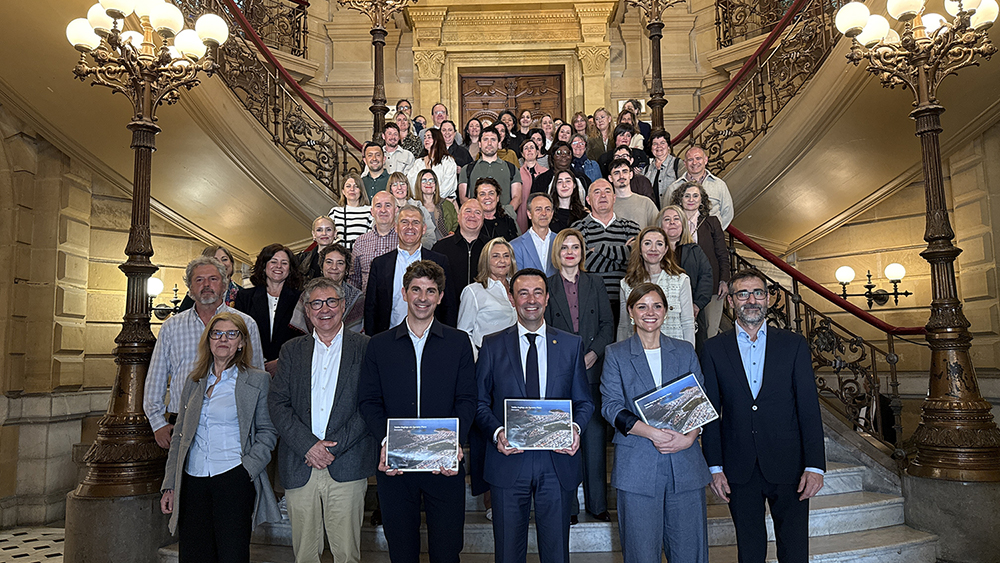
The San Sebastián City Council today presented its Local Employment and Development Plan 2026-2030. Attendees included the Mayor, Jon Insausti; the Councilor for Economy and Local Employment, Ane Oyarbide; the Second Deputy Premier, Mikel Torres; and representatives of the economic and social stakeholders who contributed to its development.
This Plan fulfills the commitment established in the Basque Employment Law 15/2023, which mandates that all local entities with more than 10,000 inhabitants must define and implement their own Economic Development and Employment Plan. In this context, Fomento de San Sebastián has led one of the eleven pilot projects launched in the Basque Country, aligned with the city´s strategic challenges and coordinated with the Basque Government´s Department of Employment.
Este Plan responde al compromiso establecido en la Ley Vasca de Empleo 15/2023, según el cual todas las entidades locales de más de 10.000 habitantes deben definir e implementar su propio Plan de Desarrollo Económico y Empleo. En este contexto, Fomento de San Sebastián ha liderado uno de los once proyectos piloto impulsados en Euskadi, alineado con los retos estratégicos de la ciudad y en coordinación con el Departamento de Empleo del Gobierno Vasco.
The development of the Plan involved the active participation of the various stakeholders that make up the city´s ecosystem, allowing for a pluralistic and shared perspective on the challenges of employment in San Sebastián. This resulted in a Plan aligned with the current and future needs of the city and its economic and social fabric.
More than 20 stakeholders from the business, association, and educational sectors, including CEBANC, CEI, Nazaret, AEHG, the Mercantile Federation, Erroak Sartu, Gipuzkoa Hotels, EMAUS, the EDE Foundation, INKOR, the University of Deusto, GAIA, the Gipuzkoa Chamber of Commerce, IES Zubiri Manteo, Tecnun, ADEGI, and Tecnalia, participated through interviews and working sessions, addressing issues such as business competitiveness, age management, employability for groups facing greater difficulties, and attracting and retaining talent in knowledge-intensive sectors.
Thirty residents of San Sebastián participated in the study, and their work histories helped identify four priority groups for employment and inclusion policies: people over 45, young people with limited professional experience, unemployed migrants, and people at risk of social exclusion.
The process also incorporated the perspectives of over one hundred companies surveyed online. Their input allowed for an analysis of current hiring processes, as well as the identification of challenges, opportunities, and short- and medium-term employment forecasts.
At the plan´s presentation, Mayor Jon Insausti emphasized that "this plan embodies San Sebastián´s values, which are so closely linked to employment, such as hard work, talent, entrepreneurial spirit, and teamwork." He added that "employment is directly linked to the well-being of every San Sebastián resident, making it a priority for the City Council," and highlighted that "high standards are one of the defining characteristics of the San Sebastián model, including in the workplace, the other being humanism".
Insausti reiterated that this Plan serves to “channel the city’s entrepreneurial spirit, whose energy and intensity are so visible at the organizational and associative levels, towards high standards of quality and competitiveness. Therefore, the plan incorporates the joint contributions of citizens, business stakeholders, and institutions, because partnerships always yield positive results in San Sebastián.” He also praised “the combination of tradition and innovation, with an urban economy that coexists with the growing knowledge ecosystem focused on science and new technologies.”
The Councillor for Economy and Local Employment, Ane Oyarbide, emphasized that this plan “is the result of serious and rigorous work, reflecting a clear and long-term city strategy that puts people at the center. Employment is a key tool for progress, not only for its capacity to generate wealth, but also for its role in integration, social cohesion, and equal opportunities. This plan focuses on groups with the greatest difficulties accessing the labor market, while also supporting young talent and entrepreneurship, and is based on a firm conviction: collaboration between institutions and stakeholders is essential to move forward and leave no one behind.”
For his part, Vice-President Torres highlighted the strategic nature of local employment plans within the framework of the Basque Employment Law, underscoring the key role of municipalities in the design and implementation of public policies aimed at employment and economic development. The councilor pointed out that this initiative represents a milestone, demonstrating that “policies designed at the local level are more effective and useful, while also embodying an approach adapted to the reality of each territory to promote decent work, social cohesion, and economic growth.” He also emphasized the importance of institutional collaboration and the role of municipalities in its implementation.
A Dynamic Economic Model Facing New Challenges of Transformation and Talent
The 2026-2030 Employment and Local Development Plan is based on a rigorous analysis of San Sebastián´s socioeconomic reality and a forward-looking perspective on the evolution of the labor market.
Currently, the city´s economic model is driven by a dual-engine approach: on the one hand, an urban economy linked to sectors such as commerce, tourism, and local services; and on the other hand, knowledge-intensive sectors supported by a consolidated science, technology, and innovation ecosystem. This model generates job opportunities for diverse.
Profiles and places San Sebastián at historically positive employment levels, with an unemployment rate of 7.2%.
From a demographic perspective, the progressive aging of the population coexists with the growing contribution of migrants, who represent 15% of the total workforce, in a labor market closely connected to the rest of Gipuzkoa.
In this context, significant challenges remain. Unemployment is concentrated among groups with greater difficulties accessing employment, such as women—especially those in caregiving roles—people over 45, and young people and migrants with low qualifications. This is compounded by factors such as part-time work and high turnover in the initial stages of employment.
At the same time, the city faces challenges that will intensify the need for generational renewal and talent, especially young and qualified talent. This requires progress in adapting the training system, promoting retraining programs, strengthening the quality of employment, and continuing to reduce gender gaps, particularly in STEM fields.
Faced with these challenges, San Sebastián starts from a solid position, supported by an increasingly skilled workforce, a robust training system, a growing innovation ecosystem, and a diversified economic fabric with the capacity to generate employment.
The Plan is designed as a strategic tool to address these challenges, strengthening quality employment, social and labor inclusion, talent development, and the competitiveness of the local economy. Three Strategic Vectors to Boost Employment and Competitiveness
The Managing Director of Fomento de San Sebastián, Iñigo Olaizola, presented the vectors that comprise the 2026-2030 Local Employment and Development Plan, which will mobilize an investment of €15.4 million. These vectors of action are embodied in 7 strategic initiatives and 45 actions.
For its first year, an operating budget of almost €3 million has already been allocated, of which Fomento de San Sebastián is assuming 55% (€1,618,857). This increased investment by the Municipal Corporation is due to strategic investments already underway, such as the Employment and Training Hub and the Bretxa Space.
The three vectors of action are:
Vector 1. Quality employment and socio-labor inclusion, which places people at the center, promoting talent development as a lever for accessing and improving employment. Among its main projects are:
The ENPLEGU-BIDEA Employment and Training HUB, located on Camino Street, which is conceived as a central hub for supporting individuals and businesses.
The UBA School Hostel and the Bretxa Space as experimental spaces for inclusive employment aimed at generating real pathways to employment.
Specific initiatives targeting women and the migrant population, promoting equal opportunities and improving accessibility to the labor market.
A commitment to young talent with various initiatives that encourage access to the job market, the improvement of skills and professional experience, as well as the return and attraction of talent to the city.
Vector 2. Entrepreneurship and competitive improvement of the urban economy, from businesses and their jobs to people. Its main actions include:
Promoting entrepreneurship and supporting the creation of new businesses with initiatives to foster an entrepreneurial culture.
Competitive and transformative improvement of the economic sectors of the Urban Economy with measures for the transformation of key sectors such as commerce, through projects focused on generational renewal, digitalization, and sustainability.
Vector 3. Governance and management of the Employment Plan, promoting greater coordination among institutions and stakeholders, from institutions and various sectoral agents to individuals and businesses, by strengthening coordination within the Basque Employment Network and the local ecosystem, with the aim of ensuring more integrated, collaborative, and results-oriented management.
The Plan incorporates a monitoring and evaluation system that will allow its impact to be measured and its actions to be adapted to the evolution of the labor market, thus ensuring dynamic and results-oriented management.
With the mission of boosting economic development and quality employment in the city from a people-centered and collaborative approach, the Plan is based on values such as quality, innovation, collaboration, and institutional responsibility, which guide all the planned actions.
With its implementation, San Sebastián takes a step forward in consolidating a more sustainable, inclusive, and competitive development model, strengthening its capacity to generate opportunities and anticipate future challenges.
Furthermore, this roadmap will be reinforced in the coming weeks with the presentation of a new Innovation Plan by Fomento de San Sebastián, which will complement the city´s strategy and consolidate San Sebastián´s position as a leader in innovation, talent, and social cohesion.